
Dan Egg: Beyond the Man Box
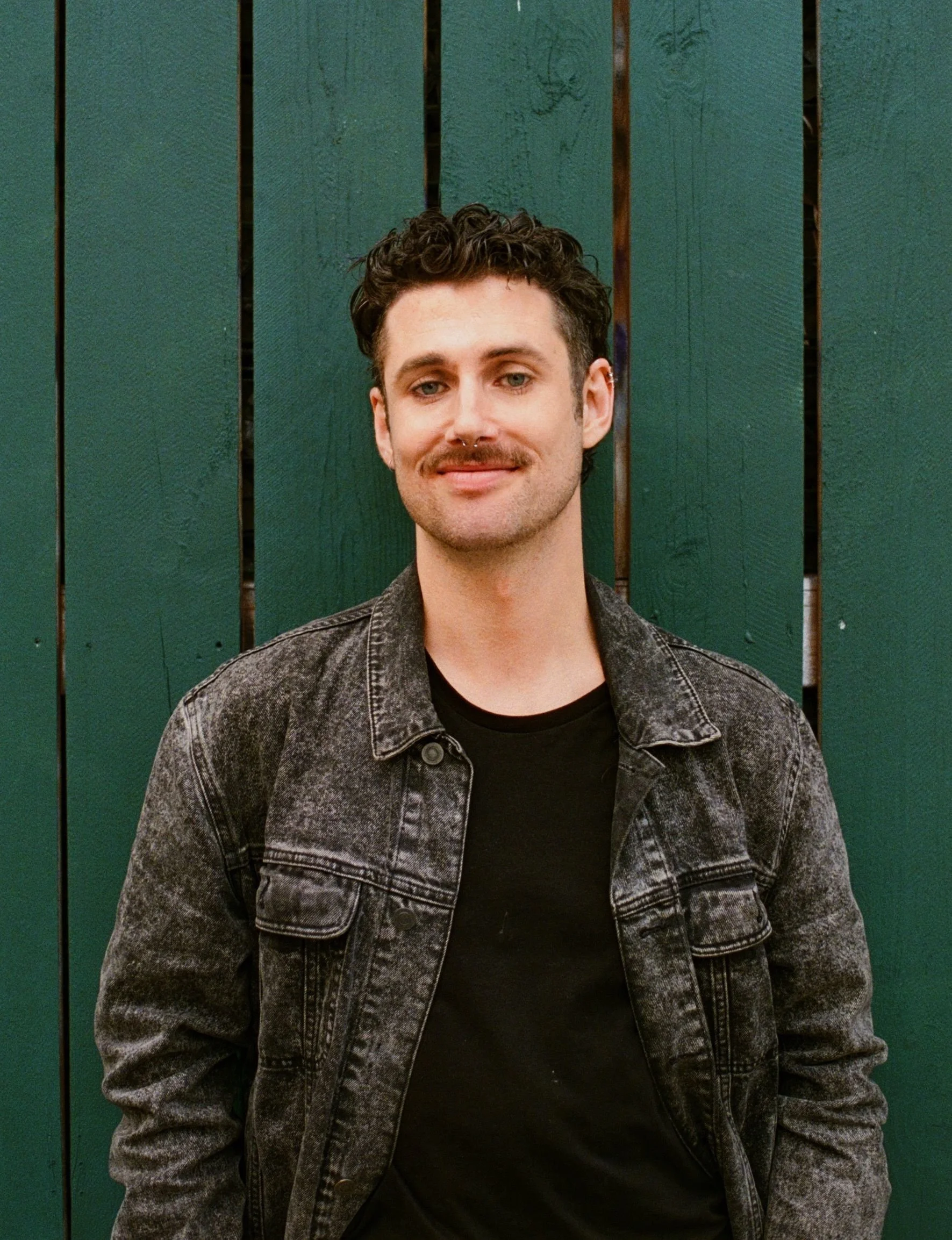
About Dan Egg
Our guest contributor, Dan Egg, is a theatre maker, journalist and content producer whose work explores masculinity, violence and queer culture. Before working in the arts, he spent several years as a child protection social worker and in the domestic violence sector, experience that directly informs his debut solo theatre show MANBOX.
Content notice: Includes references to domestic abuse and violence, grief and death. Not suitable for children and some topics may be triggering for some readers. All views expressed are those of the author.
By Dan Egg
The news
It’s 11pm and I should be asleep. I’ve just arrived in London and am staying in my best friend’s spare room, because tomorrow I begin the Arts Council funded period of research and development for my debut solo theatre show. The culmination of years of hard, unpaid work. I’ve been developing it independently for a while, but this successful funding bid means a much-needed injection of cash. I can finally bring on a creative team - director, designers and producers - who’ll help elevate the show to its full potential. Everything is moving in the right direction. I can’t wait to see what happens next.
I continue my nightly ritual of endlessly doomscrolling in bed and notice that Romesh Ranganathan just followed me on TikTok for some reason. This is objectively quite cool, so I smugly take a screenshot and post it to my Instagram Story before rolling over and shutting my eyes. My phone rings almost immediately.
My Dad has had a heart attack and I am in London. Several hours and hundreds of miles away. The paramedics are working on him but it doesn’t look good. They’re still trying.
My Dad has died of a heart attack.
My Dad has died of a heart attack and I am in London. The timing couldn’t be worse, given I’m meant to be starting rehearsals tomorrow. I berate myself for thinking this, but can’t help it.
My brain cannot comprehend the enormity of this situation, so instead it brings to mind that time Justin Timberlake was arrested for drink driving, then became a meme for saying “this is going to ruin the tour”. This is going to ruin the tour, I think. This is going to ruin my life.
There is at least a certain irony to it. My Dad dying on the eve of the rehearsals for my show. The man who changed my whole world, leaving it behind the night before I return to work on MANBOX. My show about men, masculinity, and my other dead Dad.
The box
I return home as early as I can the following morning, before swiftly realising there’s very little for me to do. The aftermath of his death involves a lot of Dead Dadmin - funeral planning, figuring out if he had life insurance, calling in to work on his behalf - but nothing that requires my immediate attention. I figure the show must go on, so before long I board my third train in 24 hours. Back to London to start rehearsals as planned, albeit a day late.
In case you were wondering, my show is called MANBOX because of my previous career in the domestic violence sector. For a while, I worked as a ‘Violence Prevention Practitioner’, facilitating workshops for men who’d perpetrated abuse in their relationships. Roughly a dozen men would attend each of these sessions, usually under strict instruction from their social worker or probation officer, and I would lead exercises designed to change behaviours and challenge beliefs. All in the name of harm reduction and building better relationships.
One of these exercises was called ‘The Man Box’. The idea is simple. I’d ask the men to list all the things that society expects of them. What a ‘real’ man is supposed to be. What he’s allowed to do. What he isn’t. These answers would often come easily: Men don’t cry. Men are strong. Men are dominant. Men don’t talk about their feelings. Men aren’t feminine. Men are providers. Men are violent. Boys will be boys.
The Man Box is a useful tool for discussing patriarchy. A way of understanding how narrow, rigid ideas about masculinity trap men inside a set of rules - and how this harms all of us. Step outside of the box, by acting in a way that isn’t deemed ‘manly’, and there are consequences. Shame. Homophobia. Violence.
Stay inside it and those same rules limit what kind of emotional life you’re allowed to have, how you handle conflict, how you relate to women, to other men, and to yourself. It’s a lose-lose situation. The box isn’t good for anyone.
It’s a great name for a show, though.
The fear
MANBOX exists because I've spent so much of my life thinking about men. Fearing them.
I can’t pretend I remember the early childhood years I spent living with my biological father (Bio Dad), but I do know they left an indelible mark. Bio Dad was a volatile, aggressive and unpleasant presence. He was also, for a while, one of the only men in my life. My primary example of what a man is. It’s hardly surprising, then, that masculinity came to feel like something dangerous.
That fear didn’t end when we stopped seeing him. It followed me into school, into friendships, into public spaces. It was reinforced through bullying at my all-boys Catholic secondary school, by homophobic strangers on the street, by drunken men at the end of a night out.
To me, masculinity has almost always been something violent; for as long as I can remember, other men have taken it upon themselves to forcibly remind me that I am not the right kind of man. So, I learnt from an early age that masculinity in its traditional form is a violent, traumatic, and damaging thing. What I come to know as I grow older is that a different kind of masculinity, outside of the confines of The Man Box, can be something that soothes pain, repairs damage, and heals wounds.
I have been afraid of men for my entire life - and this has only ever shifted, or lessened, when men have taught me how not to be. That started with my Dad; the first man I wasn’t afraid of. The first man who taught me that there is another way.
The ripples
While working with perpetrators of abuse, I’d sometimes find myself questioning how much impact I was actually having. Male violence is such a huge societal problem, on a global scale, that it can feel insurmountable. Was I really making any difference with these workshops? I wasn’t exactly changing the world, I thought.
Then, when my Dad died, I realised maybe it’s not about that.
He changed my world. Ours. Maybe that’s enough? Because changing someone’s world causes ripples outward. Slowly, and in time, those ripples reach other people - and before long, they do amount to real, wider-world change.
My mum met my Dad when she took up karate so she could defend herself from Bio Dad. Dad was the instructor. He was gentle, kind, and funny. Very much the antithesis of Bio Dad. They fell in love and before long, he took us on as his own. Happy ever after.
My Dad taught my sister karate, too, roughly thirty years ago. This started a chain reaction, ripples expanding outward. Not immediately visible at first, but in time, undeniable. Today, my sister teaches at her own karate club. She runs a company teaching karate as self-defence, helping other women just like my mum. None of that would have happened without him.
He never set out to change the world. He simply lived in a way that made the people around him feel safe. To him, that was probably nothing special. To me, it was quietly revolutionary.
My Dad taught me to believe in good men, just by being one. By choosing to live outside the box, even just a little bit. An antidote to the poison. Counteracting the damage left behind. For me, it took a good man to start to heal the wounds made by a bad one.
I think this is why, in the immediate aftermath of my Dad’s death, I went back to rehearsals. My show needed a good man in it. The best one I’ve known.
My Dad is proof that ordinary men can have an extraordinary impact. We don’t have to tear the whole box down on our own, but we can probably poke a hole in it. Just one. Enough for someone else to look out and see that there’s more.
That’s how the light gets in, how the ripples start. Small, unremarkable actions that reverberate. Imagine if we all did that.
Secure your free ticket to Voices for Change with Dan Egg, on Monday 23rd February, live via Zoom. Dan will be in conversation with White Ribbon UK CEO Lynne Elliot, to talk about the making of MANBOX, what inspired it, and MANBOX’s central theme of masculinity in today’s society.